

.
Geothermal Energy and Exploration: A Webinar on Circular Economy and Future Potential
Introduction
Welcome to the first webinar on geothermal energy and the circular economy. This session is focused on key topics such as:
-
Geothermal-based explorations
-
What geothermal energy is
-
How to find and explore geothermal reservoirs
-
Production comparisons with oil and gas
-
The role of geothermal in sustainable development
Geothermal energy is highly accessible and not just for specialists. It represents the beginning of a more sustainable, democratized energy transition.
Understanding Geothermal Systems
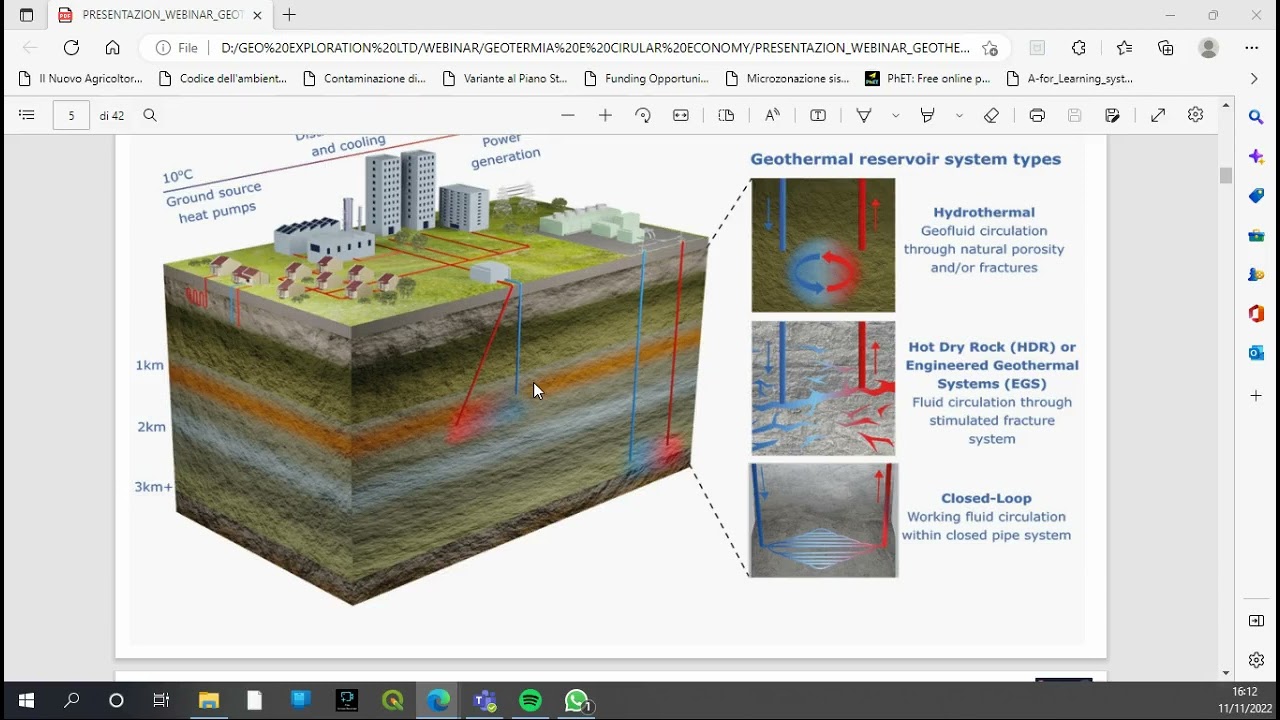
Imagine rocks beneath the Earth’s crust containing fluids—mostly water. These fluids, under specific geological and thermal conditions, can be extracted as a source of clean energy.
What we’re searching for are rocks with water, or cold rocks with water, that can constitute a driven water system.
Types of Reservoirs and Geological Settings
The type of geothermal system depends on the triple-block constitution of subsurface geology. For example:
-
Old volcanic layers (like regenerated lavas) have high potential as geothermal reservoirs due to their geological history.
-
These layers may include magmatic intrusions, carbonate rocks, and fractured deposits that favor fluid movement.
We also observe collapsed volcanic formations and examples from lakes or other sedimentary basins, all pointing to high geothermal potential.
Temperature Ranges and System Classifications
Geothermal systems can operate across a wide temperature range:
-
From 15°C to 3,000°C, depending on depth and local conditions.
Thermal systems are classified into types based on their energy transfer mechanism:
-
Water-driven systems
-
Steam-driven systems
-
Hot dry rock systems
Visual surface manifestations such as fumaroles, geysers, and thermal springs help identify active geothermal fields.
Exploration and Drilling Approaches
Exploration includes simulation of aquifers and studying both vertical and horizontal parameters of geothermal reservoirs.
Drilling strategies depend on geological geometry and resource location. Common systems include hot dry rock systems and water-bearing aquifers.
Location-Specific Potentials
Geothermal conditions and geological settings vary significantly:
-
Subduction zones often generate high pressures and temperatures.
-
Tectonic contact zones (e.g., Rift Valleys in Africa or the Apennine range in Italy) offer optimal exploration zones.
-
Europe and the USA have regions with geothermal potential, such as:
-
Tuscany and Sardinia in Italy
-
The West Coast of the USA
-
Rift zones between Africa and Oman
-
Hotspots have also been identified in Germany, the UK, and France.
Mapping and Institutional Research
In Italy, organizations such as INGV, ENI, and ENEA lead the way in geothermal mapping and research. These studies help:
-
Estimate production capacities
-
Create geothermal zoning maps
-
Define regional thermal gradients and porosity conditions
Geological Modeling and Data Collection
We collect various datasets to reconstruct 3D geological models, including:
-
Gravitational and magnetic data
-
Electromagnetic surveys
-
Geophysical and hydrogeological data
Drone and airborne surveys assist in mapping thermal anomalies and fluid pathways.
Energy Applications and Circular Integration
Geothermal energy isn’t only for electricity production. It can also support:
-
Lithium extraction (from lepidolite and spodumene-rich rocks)
-
District heating
-
Greenhouse agriculture
-
Desalination
This integration of geothermal with other technologies highlights its role in a circular economy.
Drilling Costs and Experimental Projects
Exploration and drilling costs are high, especially in experimental zones or deep crystal basement formations. However, with support from public and private initiatives, these projects are gaining momentum.
Examples include:
-
Studies in the Reno Basin
-
Faulted metamorphic zones
-
Magmatic rock formations supporting geothermal activity
Stages of a Geothermal Project
-
Initial Study – Identification of geothermal potential and surface manifestations.
-
Geophysical, Geological, and Geochemical Surveys – Collecting data for subsurface modeling.
-
First Drill – Testing subsurface conditions.
-
Data Matching – Aligning field data with simulation models.
-
Decision Point – Evaluation for commercial viability.
Final Thoughts
Geothermal energy provides an exciting and viable path for clean energy generation. It supports a sustainable and circular economy, especially when integrated with mineral extraction (like lithium) and green infrastructure. The continued development of data models and simulation technologies will make geothermal exploration more efficient, accessible, and scalable in the coming years.
For more information or to participate in upcoming studies and collaborative projects, stay connected with institutional platforms and academic partners.