


Dielectric Constants of Soil and Rock: Why They Matter in Oil and Gas Exploration
In upstream oil and gas exploration, precision is everything. Whether you’re interpreting logs, running EM surveys, or modeling the subsurface, understanding the dielectric constant of materials can directly impact drilling decisions, reservoir evaluations, and even CAPEX.
While often overlooked in favor of more familiar measurements like resistivity or porosity, dielectric constants play a vital role in how electromagnetic signals interact with subsurface formations. In this post, we’ll explore why this physical property matters, where it’s used in the oilfield, and what values you can expect from common soil and rock materials.
What Is the Dielectric Constant?
The dielectric constant (or relative permittivity) is a material’s ability to store electrical energy in the presence of an electric field. It influences how fast or slow electromagnetic (EM) waves travel through that material and how strongly they are attenuated or reflected.
In oil and gas, the dielectric constant comes into play in several key technologies:
– Dielectric logging tools
– Electromagnetic surveys
– Ground Penetrating Radar (GPR) for near-surface studies
– Petrophysical modeling and formation evaluation
Understanding a material’s electromagnetic properties allows engineers and geoscientists to better estimate fluid content, differentiate between lithologies, and fine-tune real-time interpretations in the field.
Typical Dielectric Constants for Soil and Rock
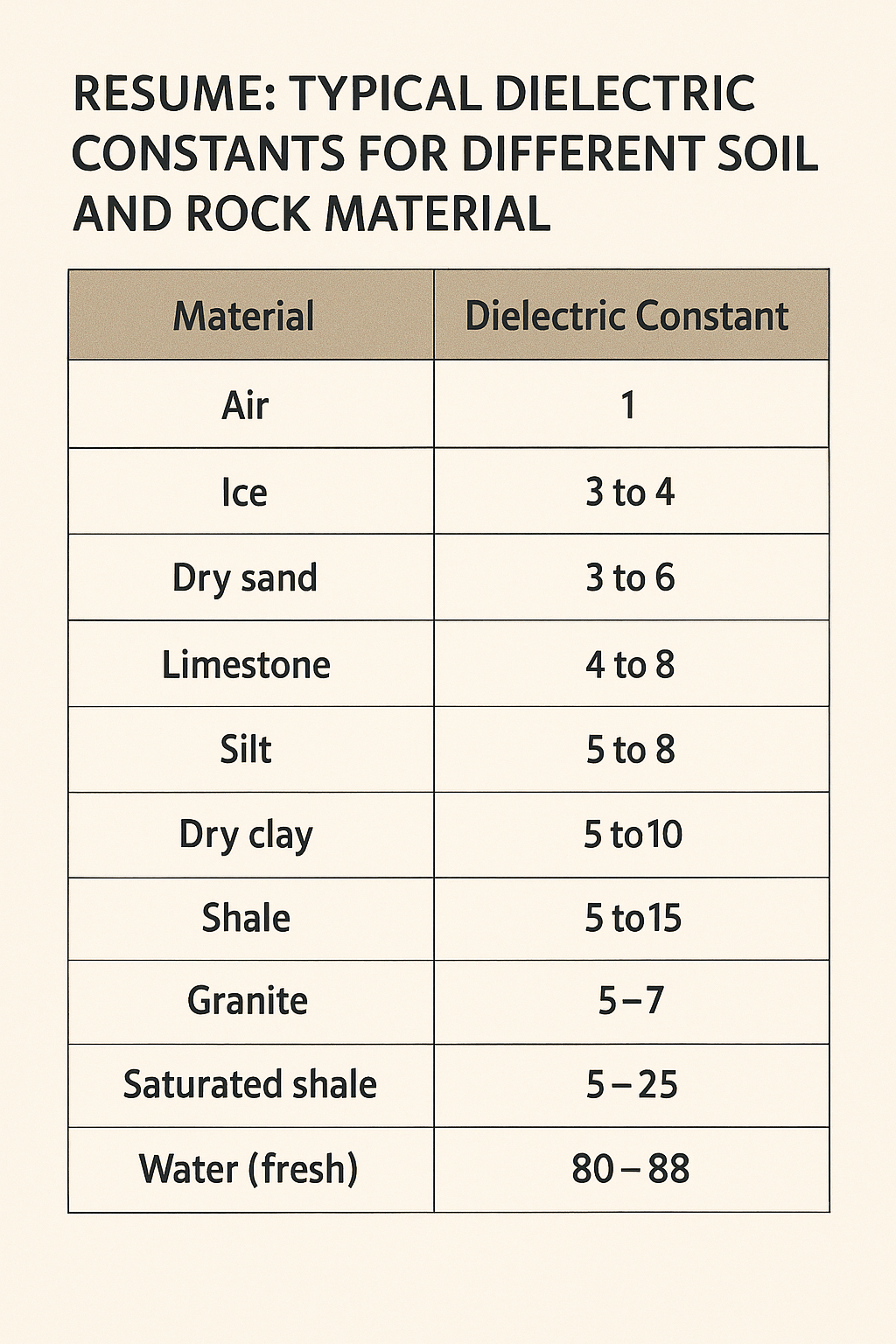
Below is a reference table of typical dielectric constants for common soil and rock types encountered in oilfield environments. These values will vary depending on porosity, fluid saturation, mineralogy, and temperature—but they serve as solid baselines for subsurface exploration and modeling.
| Material | Dielectric Constant |
|---|---|
| Air | 1 |
| Ice | 3 to 4 |
| Dry Sand | 3 to 6 |
| Limestone | 4 to 8 |
| Silt | 5 to 8 |
| Dry Clay | 5 to 10 |
| Shale | 5 to 15 |
| Granite | 5 to 7 |
| Saturated Shale | 5 to 25 |
| Water (fresh) | 80 to 88 |
These values highlight one key fact: fluid content, especially water, drastically alters dielectric behavior. For example, the shift from dry shale to saturated shale can more than double the dielectric constant—an insight that’s crucial for logging interpretation.
Dielectric Logging in Oilfield Applications
Formation Evaluation and Fluid Identification
Dielectric logs are particularly effective at distinguishing water-bearing formations from hydrocarbon-bearing zones. Since water has a much higher dielectric constant than oil or gas, this measurement adds a valuable dimension to fluid typing.
In low-resistivity pay zones—where traditional logs may be ambiguous—dielectric measurements help clarify whether you’re dealing with formation water or movable hydrocarbons.
EM Surveys and LWD Enhancements
EM technologies like logging-while-drilling (LWD) and deep-reading induction tools rely on accurate dielectric models to calculate subsurface resistivity profiles. When integrated with dielectric constants, these tools improve:
– Porosity estimates
– Saturation models
– Boundary detection in real-time geosteering
They’re especially valuable in complex reservoirs like tight sands or unconventional shale plays, where traditional logs may lack resolution.
GPR and Infrastructure Assessment
Although less common in deep reservoir applications, Ground Penetrating Radar (GPR) is used in surface and near-surface studies across oilfield sites:
– Pipeline routing and detection
– Pad integrity assessments
– Environmental monitoring
Dielectric values are essential here for calibrating GPR signal speed and reflection intensity across different soil properties.
A Closer Look: Shale vs. Saturated Shale
Let’s say your well encounters interbedded shale and saturated shale. The dry shale may range between 5–15 in dielectric constant, while saturated zones can spike to 25 or more depending on fluid type and salinity.
This contrast is enough to produce measurable signal responses in dielectric and EM logs, supporting water saturation estimates and fluid typing—even in challenging, mixed-lithology environments.
Practical Integration in Modern Oilfield Workflows
With the rise of digital oilfield technologies and integrated interpretation platforms, dielectric data is no longer a “nice-to-have”—it’s becoming standard. Petrophysicists routinely combine:
– Dielectric constants
– Resistivity logs
– Porosity
– Core data
…to create more accurate reservoir models and fluid maps. These inputs help reduce uncertainty during completion design, fracture targeting, and production planning.
The use of dielectric charts and calibrated constants across rock types is especially critical when transitioning between fresh and brackish water zones, moving from carbonate to clastic systems, or interpreting mixed mineralogy formations where logs may conflict.
As operators push into deeper, more geologically complex plays—and as exploration budgets tighten—the need for precise formation data has never been higher. Dielectric constants, when properly applied, offer one more way to de-risk decisions and extract more value from every well.
#dielectricconstant, #soilproperties, #rockphysics, #geophysics, #subsurfaceexploration, #electromagneticproperties, #groundpenetratingradar, #materialscience, #dielectricchart, #geotechnicalengineering, #formationevaluation, #resistivitylogs, #petrophysics, #oilfielddata, #shalereservoirs